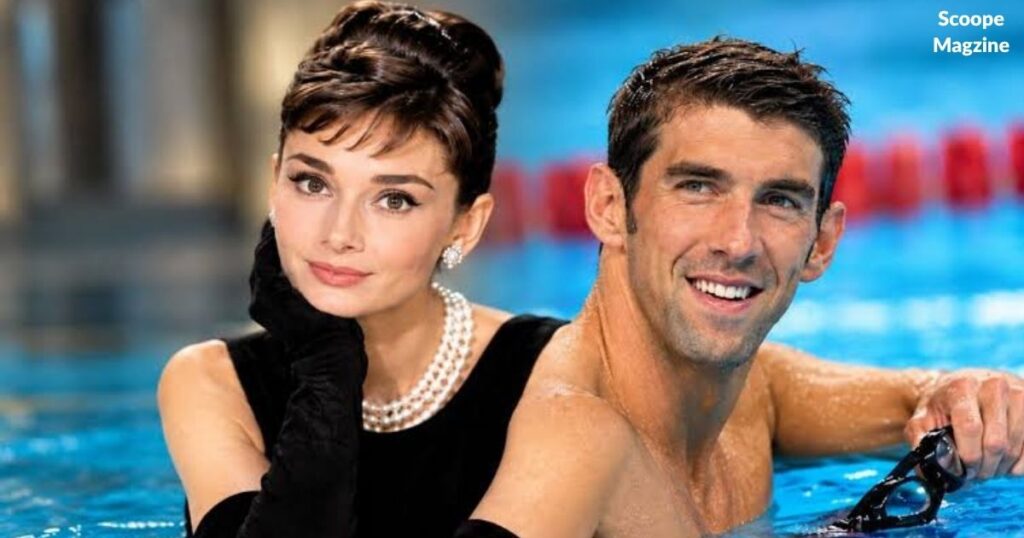
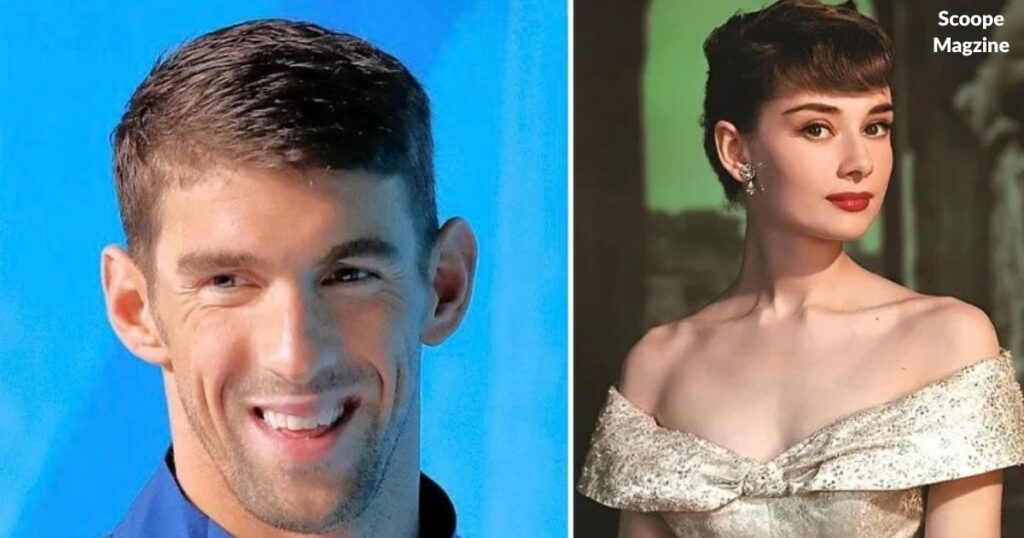
Audrey Hepburn and Michael Phelps became famous in completely different fields, yet their names are sometimes discussed together because both built extraordinary legacies. Hepburn became a symbol of classic Hollywood elegance and later devoted herself to humanitarian work, while Phelps transformed competitive swimming by setting Olympic records that remain extraordinary.
Although the two never shared a career, generation, or professional connection, their stories offer an interesting comparison. This guide explores who they were, their early lives, major accomplishments, family backgrounds, humanitarian efforts, and lasting influence. It also includes a quick biography table, a side-by-side legacy comparison, and answers to common questions about their connection.
Who Were Audrey Hepburn and Michael Phelps?
Audrey Hepburn was a British actress and humanitarian who became one of the most recognizable figures of classic Hollywood. Her graceful performances made her an international film icon, while her later work with UNICEF gave her public image another dimension that continued long after her acting career slowed down.
Michael Phelps is an American swimmer whose Olympic career established him as the most decorated Olympian in history. Across five Olympic Games, he accumulated an extraordinary medal total and created records that have made his name synonymous with elite swimming.
There was no professional or personal relationship between Hepburn and Phelps. They belonged to completely different generations and worked in unrelated fields. Their names are brought together mainly because people are interested in comparing two globally recognized individuals who achieved exceptional success in their respective careers.
Audrey Hepburn and Michael Phelps Quick Bio Table
| Detail | Audrey Hepburn | Michael Phelps |
|---|---|---|
| Full Name | Audrey Kathleen Hepburn-Ruston | Michael Fred Phelps II |
| Born | May 4, 1929 | June 30, 1985 |
| Birthplace | Ixelles, Brussels, Belgium | Baltimore, Maryland, U.S. |
| Occupation | Actress and humanitarian | Competitive swimmer |
| Known For | Roman Holiday, Breakfast at Tiffany’s, My Fair Lady | 28 Olympic medals, including 23 gold |
| Major Honor | Academy Award for Best Actress | Most decorated Olympian in history |
| Humanitarian Role | UNICEF Goodwill Ambassador | Michael Phelps Foundation and mental health advocacy |
| Status | Died January 20, 1993 | Retired from competitive swimming |
The two biographies could hardly be more different. Hepburn established her reputation through cinema before dedicating considerable attention to humanitarian causes. Phelps became famous through international athletic competition and later used his platform to discuss mental health and support related causes.
Audrey Hepburn: Early Life and Background
Audrey Hepburn was born on May 4, 1929, in Ixelles, an area of Brussels, Belgium. Her father worked as a banker, while her mother came from Dutch aristocratic roots. Because of her family background, Hepburn spent parts of her childhood in different European settings.
Her formative years in the Netherlands coincided with World War II, an experience that influenced her understanding of hardship and later became part of the background often associated with her humanitarian outlook. Before becoming a movie star, Hepburn devoted herself seriously to ballet. The discipline and posture she developed through dance later contributed to the qualities audiences noticed in her performances.
Her first acting opportunities came through smaller European screen roles. Those early experiences eventually helped open the way for her move toward Hollywood.
How Did Audrey Hepburn Become Famous?
Hepburn’s major breakthrough arrived in 1953 with Roman Holiday. She portrayed a European princess opposite Gregory Peck, and the performance quickly established her as a major new Hollywood talent. She won the Academy Award for Best Actress for the role, making the achievement an important early milestone in her career.
She went on to appear in several celebrated films, including Sabrina, Funny Face, War and Peace, Breakfast at Tiffany’s, and My Fair Lady. These performances strengthened her reputation for elegant and often understated acting.
By the end of the 1960s, Hepburn began reducing her film work. During the 1970s and 1980s, she accepted fewer projects as her priorities increasingly centered on family and humanitarian activities.
Audrey Hepburn’s Family and Personal Life
Audrey Hepburn married twice. Her first husband was actor Mel Ferrer, while her second husband was Italian psychiatrist Andrea Dotti. She had one son with each husband: Sean Hepburn Ferrer and Luca Dotti.
Later in life, Hepburn entered a long-term relationship with actor Robert Wolders. He remained her partner until her death. As her film career became less central, family increasingly occupied an important place in her life. Her experiences during wartime in Europe are also frequently connected with the compassion that later influenced her humanitarian efforts.
Read More: Lucy Elizabeth Linch Age, Net Worth, Family & Career Facts 2026
What Did Audrey Hepburn Do for UNICEF?
Audrey Hepburn became a UNICEF Goodwill Ambassador in 1988. She used her international fame to draw attention to children experiencing poverty, war, disease, and other difficult circumstances.
Her role involved much more than simply lending her name to the organization. Hepburn traveled internationally and visited UNICEF projects in countries including Ethiopia, Bangladesh, Vietnam, and Sudan. These visits allowed her to see humanitarian programs directly and communicate what she witnessed to audiences around the world.
She continued supporting the cause even as her health deteriorated. Through public appearances, fundraising activities, interviews, and speeches, she continued emphasizing the needs of children until shortly before her death.
Her humanitarian contributions included:
- Field visits: She visited UNICEF projects in more than a dozen countries and observed relief work directly.
- Public advocacy: She used interviews and speeches to bring greater attention to children’s welfare.
- Fundraising support: Her reputation and public appearances helped support campaigns designed to raise funds for international relief programs.
How Did Audrey Hepburn Die?
Audrey Hepburn died on January 20, 1993, at her home in Tolochenaz, Switzerland. She was 63 years old and had been battling cancer.
Her humanitarian work remained important even during the final period of her life. UNICEF has continued to recognize her dedication in tributes following her death. Today, Hepburn’s legacy is commonly associated with three major areas: her celebrated film career, her enduring influence on fashion and style, and her humanitarian service.
Michael Phelps: Early Life and Background
Michael Phelps was born on June 30, 1985, in Baltimore, Maryland. He began swimming when he was seven years old. Part of his introduction to the sport came from his older sisters, who were already involved in competitive swimming.
Phelps showed considerable ability at an early age. By his teenage years, he was training at an elite level with coach Bob Bowman at the North Baltimore Aquatic Club. At only 15, he qualified for the 2000 Sydney Olympics, becoming the youngest American male swimmer to make an Olympic team in decades.
How Did Michael Phelps Become the Greatest Olympian Ever?
Michael Phelps turned his early swimming ability into an extraordinary international career through intensive training and the ability to compete successfully in several swimming disciplines.
His first major Olympic breakthrough came at the 2004 Athens Games. There, he won six gold medals and two bronze medals, immediately establishing himself as one of the dominant swimmers of his generation.
His performance became even more remarkable at the 2008 Beijing Olympics, where he won eight gold medals in a single Games. He continued adding medals at the 2012 London Olympics before competing for the final time at the 2016 Rio Games.
| Michael Phelps Olympic Record | Total |
|---|---|
| Olympic Medals | 28 |
| Gold Medals | 23 |
| Silver Medals | 3 |
| Bronze Medals | 2 |
| Olympic Games Attended | 5 |
| Career Span | 2000–2016 |
These numbers explain why Phelps became known for an Olympic record that remains one of the most remarkable achievements in sports.
Michael Phelps’s Family Life
Phelps was raised by his mother, Debbie, who worked as an educator, along with his two older sisters, Whitney and Hilary. Both sisters were competitive swimmers before Michael developed his own career in the sport, helping introduce him to competitive swimming.
Phelps married Nicole Johnson in 2016, and the couple have four sons. Since retiring from competition, he has generally kept family matters more private than they were during the height of his Olympic career. Fatherhood nevertheless remains an important part of his public identity.
Why Is Michael Phelps a Mental Health Advocate?
Mental health has become an important part of Michael Phelps’s public work. He has spoken openly about experiencing depression and anxiety and has described difficult periods in his life, including a time after the 2012 Olympics when he considered withdrawing from public life.
Phelps has also discussed having been diagnosed with ADHD as a child. By talking publicly about therapy and mental health treatment, he has encouraged others, particularly athletes, to seek support when they need it.
His message frequently emphasizes that asking for professional help should not be viewed as weakness. As a result, mental health advocacy has become an important part of his post-competitive identity alongside his achievements in swimming.
How Much Is Michael Phelps Worth?
Estimates of Michael Phelps’s net worth vary considerably depending on the source. Figures commonly cited range from approximately $80 million to $120 million, with around $100 million often appearing in published estimates. There is no official public financial statement confirming an exact figure.
Much of his wealth is associated with endorsements, sponsorship agreements, business activities, and public appearances rather than Olympic competition itself. Swimming traditionally does not provide athletes with the same level of direct prize money associated with some professional sports.
| Income Source | Contribution |
|---|---|
| Olympic Competition | Relatively modest prize money associated with medal performance |
| Endorsements | Long-term partnerships with major brands |
| Business Ventures | Investments and ventures after and alongside his athletic career |
| Public Appearances | Speaking engagements and promotional activities |
| Philanthropy | Activities connected to the Michael Phelps Foundation |
His overall financial profile therefore reflects the commercial opportunities created by his international athletic reputation as much as his Olympic achievements.
Are Audrey Hepburn and Michael Phelps Related or Did They Ever Meet?
There is no documented family or professional relationship between Audrey Hepburn and Michael Phelps. Hepburn died in 1993, when Phelps was only eight years old, and there is no documented evidence that the two ever met.
Their lives unfolded in entirely separate professional worlds. Hepburn became internationally known through movies and humanitarian work, while Phelps established his reputation through competitive swimming and the Olympic Games.
Audrey Hepburn and Michael Phelps: What Do They Actually Have in Common?
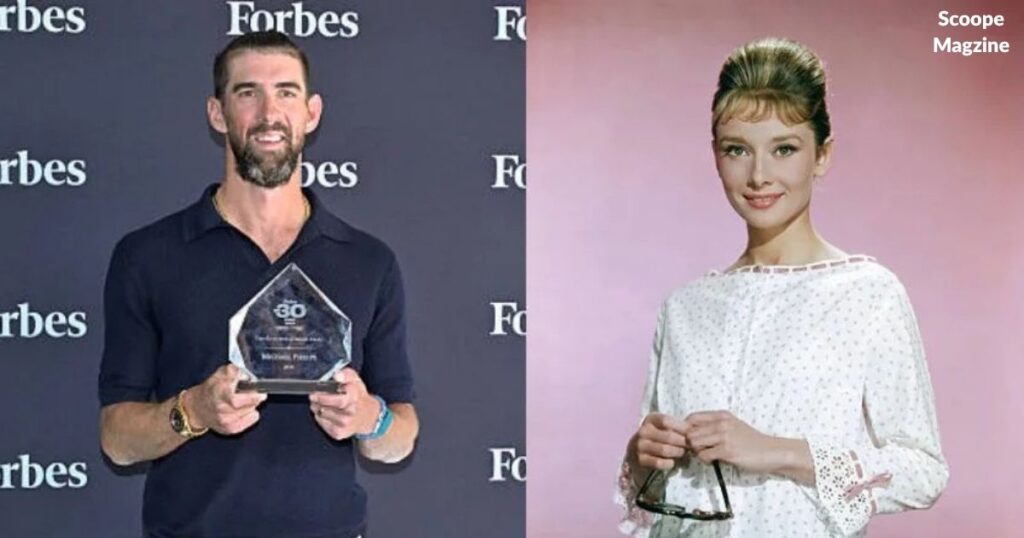
Although Hepburn and Phelps worked in unrelated industries, their stories do share several broad themes. Both reached the highest levels of achievement within highly competitive fields and later used their public visibility for purposes beyond their original careers.
Shared qualities
- Global recognition: Both became internationally recognizable names whose influence extended across generations and national borders.
- Elite-level discipline: Hepburn underwent demanding ballet training before becoming an actress, while Phelps followed an intense swimming program from childhood.
- Peak achievement: Hepburn won an Academy Award early in her film career, while Phelps collected 28 Olympic medals over five Games.
- Advocacy beyond their careers: Hepburn devoted significant time to UNICEF, while Phelps has promoted mental health awareness and programs benefiting young people.
Their careers demonstrate two very different forms of achievement: one based on artistic performance and humanitarian service, and the other built on athletic excellence and advocacy.
Audrey Hepburn vs. Michael Phelps: Achievements, Legacy, and Influence Compared
| Category | Audrey Hepburn | Michael Phelps |
|---|---|---|
| Field | Acting and humanitarian work | Competitive swimming |
| Peak Years | 1950s–1960s | 2000s–2010s |
| Signature Achievement | Academy Award for Roman Holiday | 28 Olympic medals |
| Humanitarian Role | UNICEF Goodwill Ambassador | Mental health advocacy |
| Cultural Footprint | Film, fashion, humanitarian work | Olympic sport, athlete wellbeing |
Hepburn’s legacy combines her contributions to classic cinema, her influence on fashion and style, and her later humanitarian service. Phelps’s legacy is primarily rooted in extraordinary Olympic success, followed by his willingness to speak openly about mental health and athlete wellbeing.
Frequently Asked Questions
Are Audrey Hepburn and Michael Phelps related?
No. There is no documented family relationship between Audrey Hepburn and Michael Phelps. They were born 56 years apart and came from completely different professional and cultural backgrounds.
Did Audrey Hepburn and Michael Phelps ever meet?
There is no documented meeting between them. Hepburn died in 1993, when Phelps was still a child.
Why are Audrey Hepburn and Michael Phelps mentioned together?
They are generally discussed together as a comparison between two internationally recognized figures who achieved exceptional success in very different fields. Their pairing does not come from a known personal or professional connection.
What connects Audrey Hepburn and Michael Phelps?
Both created lasting international influence through exceptional achievement. Hepburn became a major film and humanitarian figure, while Phelps established an unprecedented Olympic swimming record and later became involved in mental health advocacy.
What was Audrey Hepburn most famous for?
Hepburn is particularly remembered for films such as Roman Holiday and Breakfast at Tiffany’s. She is also widely recognized for her work as a UNICEF Goodwill Ambassador.
How many Olympic medals did Michael Phelps win?
Michael Phelps won 28 Olympic medals in total: 23 gold, 3 silver, and 2 bronze.
What did Audrey Hepburn do for UNICEF?
Hepburn became a UNICEF Goodwill Ambassador in 1988. She traveled internationally to support children’s welfare initiatives and used her public profile to raise awareness of children affected by poverty, disease, war, and other hardships. She continued this work until shortly before her death in 1993.
Why is Michael Phelps known for mental health advocacy?
Phelps has spoken publicly about his experiences with depression and anxiety and has discussed the importance of therapy and seeking professional support. His openness has helped make mental health an important part of his public work after his swimming career.
What is the main difference between Audrey Hepburn and Michael Phelps?
Their principal difference is the field in which they became famous. Hepburn built her legacy through acting, fashion influence, and humanitarian service, whereas Phelps became famous through Olympic swimming and later expanded his public work into mental health advocacy.
Final Takeaway
Audrey Hepburn and Michael Phelps never shared the same professional world and there is no known personal relationship between them. Hepburn became an enduring symbol of classic cinema, fashion, and humanitarian service, while Phelps established an extraordinary record in Olympic swimming and later became a prominent voice on mental health.
The reason their names can be compared is the scale of their individual accomplishments rather than any connection between their lives. Each achieved exceptional success in a highly competitive field and eventually used that public platform to influence issues beyond their original careers. Hepburn’s humanitarian work and Phelps’s mental health advocacy helped extend their legacies beyond entertainment and sport.